


 inquiry
 download
 RMA
RMA Product News

AI has already proven itself in digital tasks like recognizing images, translating text, and generating content, which are outputs created for human use. But the next leap goes beyond screens: physical AI. This is AI embedded into machines that can see, decide, and act directly in the physical world. Its potential stretches across industries such as logistics, healthcare, and consumer devices. In short, Physical AI is poised to redefine how we live and work by integrating AI-driven cognition with the physical capabilities of machines.
The path forward, however, is complex. Physical AI must run reliably on edge hardware, handle power and thermal limits, and pass rigorous safety tests before deployment. In this blog, we’ll break down how physical AI works, highlight real-world applications, examine the engineering challenges it faces and explore its future outlook.
What is Physical AI?
Physical AI can be defined as the class of AI systems that understand the physical properties and spatial relationships of the real world and use this understanding to make decisions or take actions in that world. Unlike generative AI, which creates digital outputs such as text, images, or video for human use, physical AI takes this a step further.
Physical AI can be defined as the class of AI systems that understand the physical properties and spatial relationships of the real world and use this understanding to make decisions or take actions in that world. Unlike generative AI, which creates digital outputs such as text, images, or video for human use, physical AI takes this a step further.
The phrase itself was brought into wider attention by NVIDIA CEO Jensen Huang, who described Physical AI as “the next big thing for AI” during his CES 2025 keynote. Since then, the term has gained traction in robotics and embedded systems communities, often framed as part of a broader “robotics renaissance.”
The process of Physical AI follows a closed perception-action loop: It gathers environmental data through sensors, interprets the information using models, formulates actions through decision-making processes, and executes those actions with actuators. The cycle repeats as outcomes are sensed again for continuous adjustment and learning.
This integration gives intelligence a physical presence, allowing it to engage with real-world environments. As a result, physical AI can effectively manage real-world constraints, such as friction, latency, power, and safety, as it closes the perception‑action loop and adapts continuously through direct contact and feedback. Positioned at the intersection of robotics, embedded systems, and advanced perception, physical AI is both a practical and cutting‑edge development in the evolution of AI.
Physical AI spans far more than traditional industrial robots performing repetitive tasks. Compared with conventional robotics that runs fixed programs in stable cells, physical AI keeps a live world model and plans in context. It fuses many sensors, handles uncertainty, and practices in simulation before moving to hardware. With reinforcement learning and feedback, it adapts without a rewrite. This makes physical AI fit for unstructured spaces with people, variable parts, and shifting conditions.
Want to see the contrast in detail? We’ve written a full post on How Physical AI Differs from Traditional Robotics
How Does Physical AI Work?
Physical AI is built on a closed loop that turns perception into action. Machines sense their surroundings, interpret what they see, and act on that knowledge. In practice, the process can be broken into six stages: Modeling and simulation, sensing and perception, processing, decision making, action, and feedback loop.
1. World Modeling and Simulation
A Physical AI must develop a model of the physical world in which it operates. This often begins with creating digital twins, a detailed virtual replicas of real environments, processes, or objects. Digital twins provide a safe, controllable sandbox where AI models can learn the “rules” of physics without real-world risks. For instance, an autonomous factory robot’s AI might be trained in a simulated warehouse populated with virtual shelves, boxes, and people, governed by realistic physics (gravity, friction, lighting, collisions). NVIDIA’s generative physical AI approach heavily relies on simulation; highly accurate 3D environments (e.g. using the Omniverse platform) are used to generate training data that encodes spatial relationships and physical behaviors.
The simulation serves both as a data generator (producing labeled scenarios far beyond what could easily be collected with real sensors alone) and as a training ground for developing and testing AI decision-making. By the time a Physical AI agent is deployed in reality, it has already “experienced” thousands of hours or more in a physics-accurate virtual world. This world modeling is essential to cope with the vast variability and complexity of real life – the AI develops an abstract but predictive understanding of how it can expect the world to behave.
2. Sensing and Perception
Fundamentally, physical AI runs as a continuous perception-to-action pipeline. Once deployed, a Physical AI system continuously ingests data from the real environment through multimodal sensor suites: vision (cameras, depth sensors), range finding (LiDAR, radar, ultrasonic), touch (tactile pads, force sensors), audio (microphones), and more.
Advanced Physical AI designs use neural network models (often variants of vision–language models or multimodal transformers) to interpret sensor data in context and even to query for missing information. The spatial knowledge and situational awareness that result are what enable an autonomous machine to make intelligent choices (e.g. distinguishing a person from a pallet, or understanding that a slippery floor might affect its movement). In summary, robust perception forms the eyes and ears of Physical AI, bridging the gap between continuous real-world signals and the AI’s decision logic.
3. Processing and Algorithms
Next comes processing and algorithms, often realized through reinforcement learning (RL) or similar AI planning algorithms. In a typical RL-driven architecture, the AI has learned a policy (a mapping from observed state to action) through extensive simulation-based training. Neural networks, sensor-fusion architectures, and state estimators work to extract meaningful data such as objects, depth, motion, and scene context. This information is then used to construct a continuous model of the device’s surrounding environment.
Modern robotic brains, like NVIDIA’s Jetson AGX Orin and the new NVIDIA’s Jetson AGX Jetson Thor, pack GPU and specialized AI accelerators that deliver server-class compute on a compact module for a robot. These hardware platforms support popular AI frameworks (TensorFlow, PyTorch) and are optimized for running complex models such as Cosmos Reason, Llama, or domain-specific models for robotics.
Curious about which platform better fits your physical AI workload? Read our full comparison: NVIDIA Jetson AGX Thor vs Orin
4. Decision-Making
Decision‑making layers then convert that model into intent. During training, the system receives positive rewards for actions that achieve desired outcomes, and negative feedback for undesired results, driving it to improve over millions of simulated trials. This process teaches the AI agent how to perform complex skills safely and efficiently, whether it’s balancing a robot on two legs or routing a delivery vehicle through traffic. Crucially, RL allows the agent to continue adapting – even after deployment, some systems can keep learning (within safety bounds), refining their behavior with each new experience.
This means a Physical AI can handle new situations that were never explicitly programmed, by leveraging its learned principles of cause and effect. For instance, if a warehouse robot encounters a new type of obstacle, its trained policy combined with on-line learning might let it quickly figure out how to navigate around it. Another aspect of decision-making is real-time control: embodied AI agents often need to make split-second decisions due to their physical nature
Planners and controllers select trajectories, tasks, or interaction strategies, while safety subsystems enforce constraints such as collision avoidance or speed limits.
5. Action
This is followed by actions that are executed through actuators. Motors drive wheels and arms, valves open and close, displays update, or haptics provide feedback.
6. Feedback Loop
The effects of those actions are sensed again, closing the feedback loop so the system can adapt, correct errors, and learn over time. This loop — sense, compute, decide, act, observe — is what lets physical AI move from reactive behaviors to purposeful, reliable autonomy.
Real-World Applications
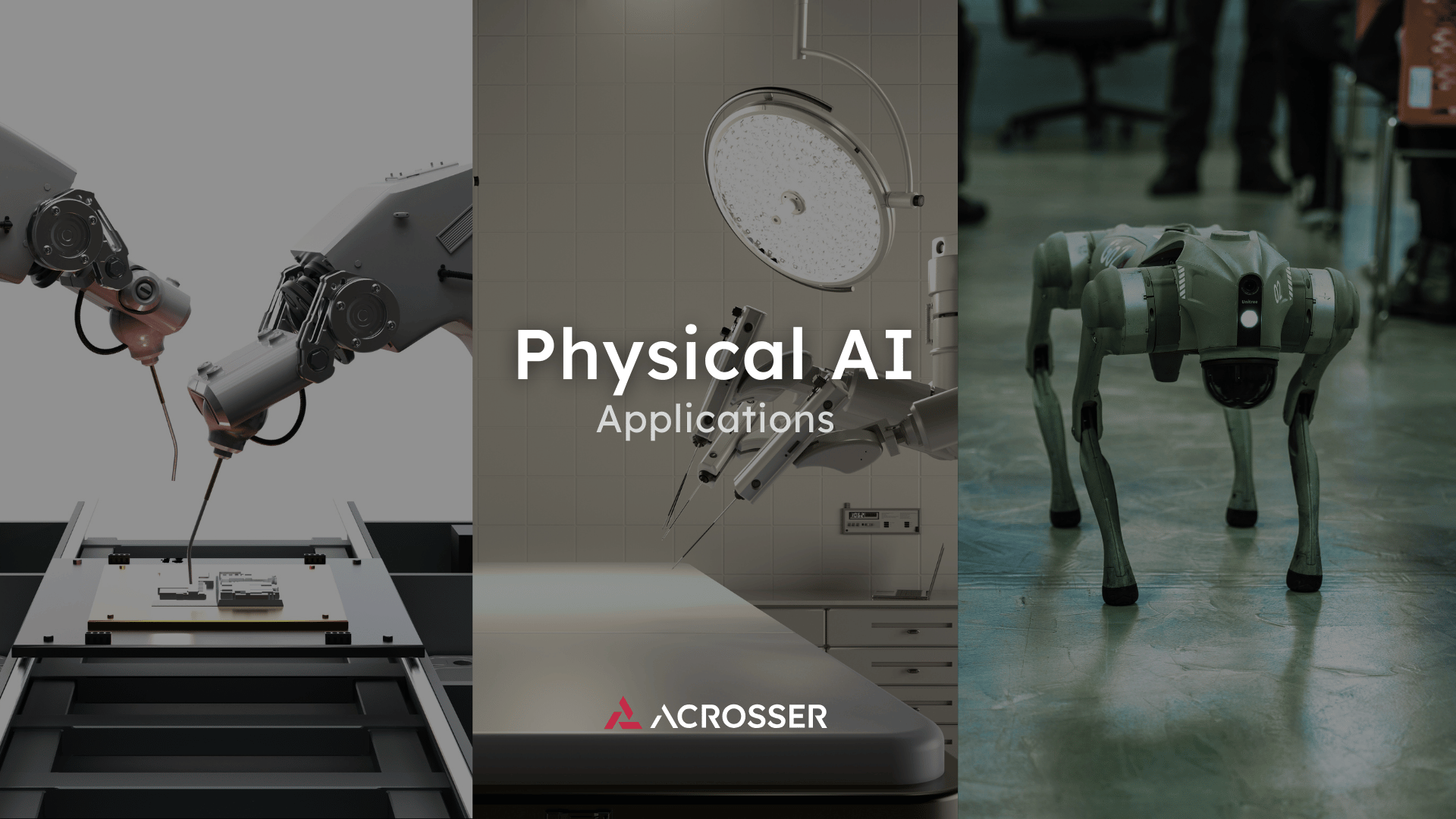
Physical AI is already changing how work gets done. By combining cognitive intelligence with real-time actuation, Physical AI systems are unlocking new levels of efficiency, safety, and capability in areas that until recently relied solely on human labor or dumb automation. Some notable cross-industry applications include:
1. Manufacturing and Industrial Operations
Physical AI is revolutionizing factories and supply chains through adaptive automation. In smart factories, AI-powered robots and systems can perform real-time optimization of processes, adjusting to changing conditions on the fly without human intervention. For example, robotic arms on an assembly line can learn to handle new product variants or recover from disruptions (like a temporary machine failure) by rerouting tasks without needing to pause production for reprogramming.
2. Healthcare and Medical Robotics
In operating room, surgical and assistive robots combine high‑precision sensing with force feedback to aid surgeons or help patients with daily tasks. These systems use AI to interpret medical images and sensor data in real time, adjusting their movements on the fly - for instance, industrial inspection uses drones and ground robots that inspect turbines, bridges, or pipelines, then perform corrective actions when problems are found.
Outside the operating room, service robots and AI-driven assistive devices are helping with routine tasks like medication delivery, patient monitoring, or even providing companionship. Because they are powered by Physical AI, these helpers can safely navigate crowded, dynamic environments like a busy ward, understand and respond to spoken instructions or gestures, and adapt to individual patient needs.
3. Retail and Service Robots
In retail settings, Physical AI is enabling a new generation of service robots and intelligent store infrastructure. For instance, warehouses and big-box retailers use autonomous inventory robots that roam aisles, using computer vision to scan shelves for stock levels or misplaced items.
Fast food and hospitality industries are also deploying physical AI in the form of robot chefs, baristas, and servers. One example is Miso Robotics’ “Flippy”, a robotic fry cook. Flippy uses AI-driven vision (thermal and 3D cameras) to monitor each burger patty or basket of fries and cook it to the proper time and temperature.
Moreover, retailers and restaurants are looking beyond store walls by deploying autonomous delivery robots as part of their service. These small, self-driving robots can carry groceries, meals, or parcels directly to customers’ homes. Equipped with cameras, LiDAR, radar and GPS, delivery robots navigate sidewalks and street crossings using AI to interpret their surroundings and avoid hazards.
4. Smart Cities and Environments
Scaling up from individual machines, Physical AI is being applied to smart infrastructure at the city and even global level. Cities are employing AI systems with physical awareness to manage traffic and public safety. For example, AI that analyzes feeds from traffic cameras and IoT sensors can dynamically adjust traffic light timings, re-route vehicles, or dispatch resources, thus optimizing traffic flow and reducing congestion.
Another use is in environmental monitoring, networks of AI-enhanced sensors track pollution levels, noise, or waste, and then automatically trigger interventions like adjusting traffic or alerting citizens.
Across these examples, the common thread is AI systems that sense and reason about physical spaces, leading to environments that effectively “cooperate” with humans to improve quality of life.
5. Autonomous Vehicles and Transportation
One of the most revolutionary physical AI systems is the autonomous vehicle. Self-driving cars, taxis, and trucks are now being tested (and in some areas deployed commercially) to carry passengers and freight on public roads.
Using computer vision and machine learning, an autonomous car continuously identifies lane markings, traffic signs, other vehicles, pedestrians, and obstacles, even at long distances and 360° around the vehicle. It then uses this understanding to control the steering, acceleration, and braking instant by instant – effectively acting as a cognitive driver.
Challenges — Chip, Performance, and System Integration
Deploying physical AI outside controlled lab conditions brings a set of hard engineering trade‑offs. High‑accuracy perception and advanced behavior models require substantial computing, but many robots and edge devices are limited by battery capacity and thermal capacity.
That creates a difficult processing vs. power trade‑off: simplify models to save energy, or design for high throughput but accept reduced runtime. As a result, optimal deployment strategies are required, favoring a hybrid approach to balance performance with resource constraints.
Latency and real‑time constraints add another hurdle. Tasks such as collision avoidance, force control, or human‑robot interactions require millisecond‑level responsiveness. Offloading inference to the cloud leads to unacceptable latency and reliability issues. As such, that pushes computing and inference onto the device, where determinism and fast interrupts are essential.
One major challenge in building reliable AI, especially for physical systems, is sensor fusion. It requires combining data from different types of sensors that sample at different rates and can each suffer from noise or failures.
To ensure safe and reliable operation, these systems require sophisticated mechanisms for robust synchronization, precise calibration, and models designed to gracefully handle missing or unreliable inputs.
Compounding these problems are the practical limitations imposed by thermal and form-factor constraints. High computing density, a common requirement for advanced AI processing, generates substantial heat, which can negatively impact the performance and longevity of nearby components.
Furthermore, the physical dimensions and placement restrictions of modules on a given platform significantly limit design flexibility and can exacerbate thermal management issues, creating a delicate balance between computational power and system integrity.
Developing physical AI presents unique challenges for trust, safety, and certification due to its real-world interaction. This requires rigorous testing, fault-tolerant design, and adherence to extensive standards and regulations, significantly prolonging development compared to software-only AI.
These challenges all lead to one clear conclusion: the computing platform and module design are decisive. A purpose-built edge robotics module that places high-efficiency computing close to sensors and actuators can reduce power use, cut latency, ease integration, and simplify deployment.
Bringing Edge Computing to Physical AI with ACROSSER
ACROSSER’s EAR‑100T NVIDIA Jetson Thor robotics controller brings powerful edge computing directly to physical AI in a compact, integration‑ready package.

Accelerated by NVIDIA® Jetson T5000™, the module delivers the throughput needed to run large perception and control models on the device. This on‑device processing in turn reduces reliance on the cloud and removes network latency from safety‑critical control loops.
Our controller also increases sensing and perception with frame-level synchronized multi-camera support, delivering reliable 360° perception that helps robots maintain full situational awareness in dynamic environments.
Learn more about ACROSSER’s EAR-100T and apply for a free 90-day trial here
EAR-100T brings efficient, high‑performance computing power physically close to sensors and actuators, turning physical AI into practical, deployable solutions.
Future Outlook — Why Physical AI Matters
The next wave of physical AI will be driven by advancements in sensor-fusion foundation models. These models, characterized by their large and more generalized behavioral capabilities, will be able to interpret diverse multi-modal inputs and apply learned skills across various tasks.
These models amplify capability but increase the need for edge‑first AI deployment: privacy, reliability, and latency requirements push inference and continual learning onto devices. As systems evolve from automation to augmentation, robots will increasingly function as collaborators that enhance human capabilities. These co-workers will assist rather than replace humans.
Ultimately, the speed at which physical AI scales will hinge on chip innovation and integration. Smarter, more efficient silicon combined with well‑engineered modules determines how quickly capabilities leave the lab and enter everyday environments. Crucial for building practical, safe, and widespread physical AI, solutions such as the EAR‑100T achieve this by combining high computing density, power efficiency, and seamless sensor integration.

Monthly insights and updates. No spam. Just what matters.
We partner with tech leaders to turn ideas into reality, from concept to deployment.
