


 inquiry
 download
 RMA
RMA Product News

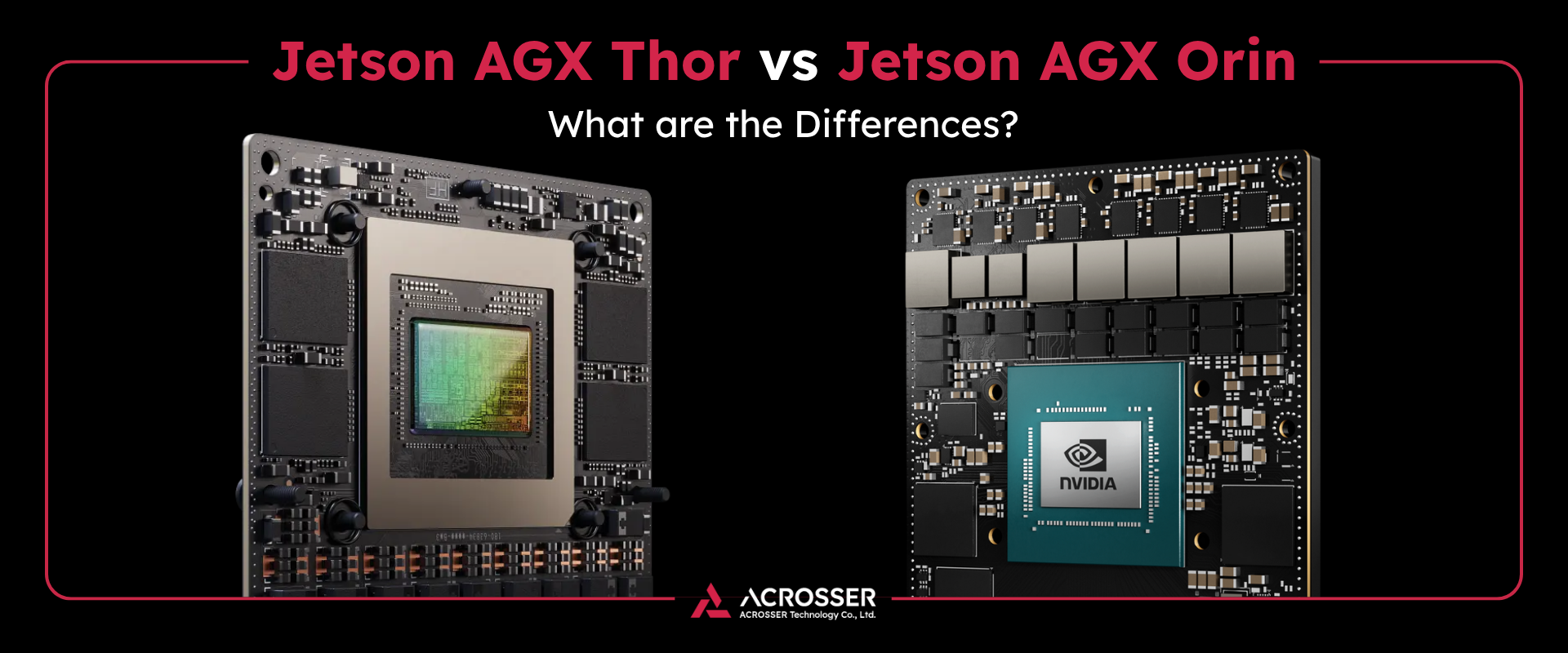
NVIDIA’s Jetson platform has long shaped what’s possible for AI at the edge, powering physical AI, drones, and autonomous systems across industries. With the introduction of Jetson AGX Thor, built on the new Blackwell GPU architecture, developers now have another option alongside the established Jetson AGX Orin, based on Ampere. On paper, Thor delivers a major step up, with up to 7.5 times the AI compute and about 3.5 times the energy efficiency of Orin.
While the performance leap is undeniable, the real measure lies in how it impacts engineering decisions. For some teams, Orin’s track record and field-proven stability may make it the dependable choice. For others, Thor’s leap in compute and efficiency could unlock entirely new levels of capability. The question is not just how powerful Thor is, but how the strengths of each module align with different project needs.
This comparison sets the record straight. We’ll start with a detailed spec table, then explain how each metric plays out in practice. We’ll also look at migration considerations and the software ecosystem. By the end, you’ll see where each platform stands and where the real trade-offs lie.
NVIDIA Jetson AGX Thor vs NVIDIA Jetson AGX Orin
To ground the discussion, the table below compares key specifications of NVIDIA Jetson AGX Thor versus NVIDIA Jetson AGX Orin (Ampere generation). This focuses on the flagship modules of each generation (Thor’s Jetson T5000 module vs. Orin’s 64GB AGX module) for an apples-to-apples comparison.
| Component | Jetson AGX Orin (Ampere Gen) | Jetson AGX Thor (Blackwell Gen) |
| CPU | 12-core Arm Cortex-A78AE v8.2 @ ~2.2 GHz (64-bit, 3 MB L2 + 6 MB L3) | 14-core Arm Neoverse-V3AE @ up to 2.6 GHz (64-bit, 1 MB L2 per core, 16 MB L3) |
| GPU | NVIDIA Ampere GPU, 2048 CUDA cores + 64 Tensor Cores; no MIG (single-instance GPU) | NVIDIA Blackwell GPU, 2560 CUDA cores + 96 Tensor Cores (5th-gen); supports Multi-Instance GPU (MIG) |
| AI Features | INT8: up to ~275 TOPS (marketing figure). GPU INT8: ~170 sparse TOPS; DLAs add up to ~105 sparse TOPS | FP4: 2070 (sparse) / 1035 (dense) TFLOPs. FP8: 1035 (sparse) / 517 (dense) TFLOPs. FP32 (CUDA): 8.064 / 7.096 TFLOPs. (NVIDIA note: FP8 TFLOPs ≈ INT8 TOPS) |
|
Memory (Type & Bandwidth) |
Up to 64 GB LPDDR5 @ 256-bit, ~205 GB/s bandwidth (64 GB module) | 128 GB LPDDR5X @ 256-bit, ~273 GB/s bandwidth |
| Power (TDP) | Configurable 15 W to 60 W (max). Lower power envelope suits battery-powered or thermally constrained devices. | Typical operating range 75–120 W for full performance. Requires robust cooling/power |
CPU Architecture & Core Counts
Jetson Thor can handle more CPU-intensive tasks or background processes without saturating, which is beneficial for complex robots that need to run real-time control loops, perception, and higher-level reasoning concurrently. The Neoverse V3 cores bring PC/server-grade processing to the edge, which helps for things like physics simulation, path planning, or running traditional algorithms alongside neural networks. By contrast, Jetson Orin’s CPU – while no slouch – may become a bottleneck if an application has heavy non-GPU workloads (for example, CPU-bound sensor processing or extended ROS 2 computations). Orin’s 12 Arm Cortex-A78AE cores were a step up from Xavier’s 8 Carmel cores, but Thor’s CPU is another substantial jump: NVIDIA even describes Thor’s CPU as “robust”, emphasizing its role in low-latency, real-time processing alongside the GPU.
For developers, one consideration is software thread distribution. On Orin, offloading work to the GPU and using accelerators was often essential to meet real-time constraints, because the CPU, though multi-core, could be taxed by complex workloads. With Thor, the beefier CPU may handle more on its own – for example, high-frequency control tasks or large dataset pre-processing – potentially simplifying software architectures. It also implies that moving from Orin to Thor could involve re-balancing CPU/GPU usage to take advantage of the new CPU headroom.
GPU Architecture & Cores
For AI inference and vision processing, Jetson Thor’s GPU is significantly more powerful. It delivers up to 1035 FP8 TFLOPs (sparse) or 2070 FP4 TFLOPs (sparse), depending on model precision, while Orin 64GB tops out at 170 INT8 Sparse TOPS on the GPU (275 TOPS marketing figure includes platform accelerators). That headroom lets you run bigger models or more concurrent models at real-time rates.
The addition of MIG on Thor is very relevant for robotics systems or physical AI that have mixed-criticality workloads. For instance, one MIG partition could be reserved for real-time perception (e.g. obstacle detection camera DNNs that must run at a steady 30 FPS), while another partition handles a less critical task like an NLP model or UI rendering. On Orin, all tasks share the GPU and one heavy model could momentarily starve others of
GPU cycles, whereas Thor can hard-partition GPU slices to guarantee performance isolation. This is a big plus for designing safety-conscious systems.
For developers, existing INT8 and FP16 models run on Thor without modification, and FP8 can be enabled with NVIDIA’s Transformer Engine APIs for additional speed. This backward compatibility protects current work while offering clear paths to optimization.
AI Performance
Many AI models today can run at reduced precision without significant loss in accuracy, especially if quantization-aware training or fine-tuning is used. NVIDIA’s Transformer Engine in Thor dynamically chooses between FP4 and FP8 for different parts of transformer models to maximize speed while preserving accuracy. This allows models that might need FP16 on Orin to run in FP8 on Thor, effectively doubling throughput. FP4 support also hints at research in ultra-low precision, which could be useful for certain generative AI tasks or for ensemble models where memory is a constraint.
For a robotics engineer, the raw numbers translate to capability. With Orin’s ~275 TOPS, a robot might budget 50 TOPS for object detection, 50 for segmentation, 20 for pose estimation, etc., and still could run several tasks concurrently at real-time. With Thor’s up to 1035 FP8 TFLOPs (sparse) ≈ ~1035 ‘equivalent’ INT8 TOPS per NVIDIA’s note, the same robot could add transformer-based vision-language models or reinforcement learning policies without leaving the edge. This enables more autonomous functionality without cloud offloading. For instance, Thor can run large vision-language-action models (like NVIDIA’s new Isaac GR00T family) in real time at the edge, whereas Orin might struggle or not fit those models in memory/performance budget.
Memory Configuration and Bandwidth
Jetson Thor’s memory upgrade is a crucial enabler for advanced AI at the edge. It complements the GPU’s capabilities: you can actually load those giant models and data that the GPU can crunch. Jetson Orin’s memory, while large by embedded standards, might limit ultra-large-model applications (like > billions of params or high-res sensor fusion). For many current robotics tasks, 32 GB suffices, and Orin’s memory speed is not a bottleneck. But Thor is built for the next generation where robots could be running simultaneous multi-modal AI workloads and maintaining rich world models in memory. Essentially, Thor’s memory subsystem turns it into a “supercomputer on a module” – bridging a gap where previously one might need a connected server to handle such scale.
Process Node and Efficiency
For end users, process node is not something visible, but it is experienced as performance or power consumption. Jetson Thor can fit server-class capability in nearly the same footprint as Orin at about 100 × 87 mm. Thor’s GPU runs at 1.57 GHz while maintaining efficiency per core.
Engineers should note that newer nodes can bring different operating requirements. Thor’s dense circuitry may be more sensitive to voltage drop and require cleaner power delivery on the carrier board, though NVIDIA has accounted for this in the module design. Newer nodes can also mean higher wafer costs and tighter supply early in production. Orin’s platform is more mature in market availability, which can translate to broader near-term module and carrier options.
Power Consumption (TDP)
From a system cost perspective, more power requires stricter regulators, larger batteries, and bigger coolers, which add weight and volume. Orin can scale down to around 15 W, making it suitable for lightweight robots or wearable devices that need low idle power. Thor’s minimum of about 40 W sets a higher floor, even with always-on cores handling light tasks, so it is less practical in those scenarios.
Thermal and power management remain important for both, but Thor raises the bar. Orin could throttle under heavy load in warm conditions, and Thor will require systems built to dissipate over 100 W reliably. This makes Orin the better fit for power- or heat-constrained applications, while Thor is designed for robots that demand maximum performance and can accommodate a larger power envelope.
Software Ecosystem and Migration
Migrating from Jetson Orin to Jetson Thor is straightforward. Both share the same NVIDIA AI software stack, with Thor introducing JetPack 7 on Ubuntu 24.04 LTS (with Linux kernel 6.8) and CUDA 13. API compatibility ensures applications built with CUDA, TensorRT, OpenCV, and ROS on Orin run on Thor with little change, often faster out of the box. Developers can also re-optimize for FP8 to gain additional speed while continuing to use frameworks like PyTorch and TensorFlow. Isaac SDK and Isaac ROS migrate smoothly, and Thor’s larger compute budget with MIG support allows heavier models, higher resolutions, and split workloads to run reliably.
Hardware and ecosystem form the main differences. Thor is not pin-compatible with Orin, so new carrier boards are required, though vendors are already preparing updated solutions with BSP support. Orin benefits from years of maturity and community knowledge, while Thor enters as the newer platform with fewer references at launch.
Decision Guide: Choosing Jetson Thor or Orin
Ultimately, the choice between Jetson Thor and Jetson Orin should be driven by your project’s requirements and constraints. Below is a neutral guide to help decide which module is appropriate given various considerations:
Consider NVIDIA Jetson Thor if…
- You need maximum edge AI performance and “future-proofing”: Your application involves cutting-edge models (e.g. transformer-based vision, large language models, multi-modal perception) that push the limits of Orin. Thor’s 7.5× AI throughput lets you run these advanced workloads in real time.
- Your robot/system has heavy multi-tasking demands: For example, a humanoid or autonomous vehicle doing vision, language, planning, and control simultaneously. Thor can partition resources (via MIG) to handle multiple critical AI tasks in parallel without interference, whereas Orin might struggle to schedule them all smoothly.
- High-bandwidth sensors or many sensors are in the mix: If you are integrating numerous cameras, high-res lidars, or radar arrays – essentially a sensor fusion powerhouse – Thor’s superior I/O (4×25GbE, PCIe up to Gen5 x8, etc.) and memory (128GB) can ingest and process that firehose of data in real-time.
- Edge training or on-device learning is part of the plan: If you foresee doing model fine-tuning or learning at the edge (e.g., personalized models updated on the device), Thor’s extra compute can significantly shorten training times or enable training of larger models locally. Orin is generally inference-only for anything but small models.
- Your power/thermal budget can support it: You have the ability to cool ~100–130 W and supply that power. For instance, your robot is large enough for active cooling and has a robust battery or a continuous power source.
- Longevity and next-gen roadmap alignment: You plan to deploy/scale in 2024–2028 and want the platform that will stay high-end for that whole period. Thor, being newer, will have a longer effective lifespan at the top of NVIDIA’s Jetson lineup (until the next-gen after Thor arrives). It may receive software updates and support longer into the future, aligning with long product cycles.
Consider NVIDIA Jetson Orin if…
- Your application’s performance needs are fully met by Orin today: If a single Orin (or even an Orin NX) can already achieve your required frame rates and response times for AI tasks, Thor would be overkill. For example, if you just need to run a couple of CNNs at moderate resolution, Orin’s 275 TOPS is sufficient and more power-efficient at that operating point. It’s sensible to choose the simpler, proven solution that meets requirements with margin.
- Power, size, or heat are critical constraints: If you’re building a battery-powered device, a compact drone, or a passively cooled system, Orin is a better fit with its 15–60 W profile.
- You value a mature ecosystem and existing integrations: Orin has been on the market longer – many off-the-shelf carriers, sensor drivers, and software examples are available and well-tested. If time-to-market and low risk are priorities, Orin’s ecosystem maturity is a big plus. You can tap into community forums, established best practices, and a wealth of documentation from thousands of Orin deployments.
- Cost considerations (bill of materials): While we don’t detail pricing, it’s generally true that Orin modules (and the surrounding components for cooling, power) will be more affordable than Thor, given Thor’s high-end positioning. If you’re trying to keep the unit cost of your device in check and don’t need Thor’s level of performance, Orin is more economical. It also uses less expensive support infrastructure (smaller heatsinks, lower-spec power supplies, etc.).
- Your application is already deployed on Xavier/Orin and stability is key: If you have a working product on Jetson Xavier or Orin and it meets customer needs, there may be no need to migrate to Thor in the near term. Orin will continue to be supported by NVIDIA (JetPack updates, security patches) for its life cycle.
- When “proven in the field” outweighs “bleeding edge”: For use cases like medical devices or certified equipment, sometimes the newest tech isn’t immediately desirable because it may take time to validate and certify. Orin, being proven in real-world deployments (with 7k+ customers), might inspire more confidence for conservative industries initially. Until Thor has an equal track record, Orin is a safer bet in these contexts.
- Lower heat output for human-facing robots: If your robot works in close proximity to people (say a retail or hospital robot) and you want to minimize waste heat or fan noise, Orin’s lower TDP is beneficial. It can often be cooled quietly or passively. Thor, at full tilt, will generate more heat and likely require more audible cooling solutions, which might be a consideration in certain environments.
In essence, choose Jetson Thor for the most demanding, cutting-edge applications where its strengths (extreme performance and advanced features like MIG and lockstep cores) can be fully utilized. Choose Jetson Orin for applications that fall within the current state-of-the-art in edge AI and where efficiency, lower power, and a well-trodden path are priorities. In many cases, Orin can handle what you need today, and Thor is what you’d consider for what you might need tomorrow – it’s about aligning the tool to the job.
ACROSSER is a proud product partner with EverFocus in developing NVIDIA-powered industrial PC lineups. These systems integrate Jetson technology to bring edge AI computing to industries such as physical AI, surveillance, transportation, and automation.
Curious about how NVIDIA Jetson Thor performs in real-world applications? Apply for a 90-day free trial and experience the power of edge AI firsthand.

Monthly insights and updates. No spam. Just what matters.
We partner with tech leaders to turn ideas into reality, from concept to deployment.
