


 inquiry
 download
 RMA
RMA Product News

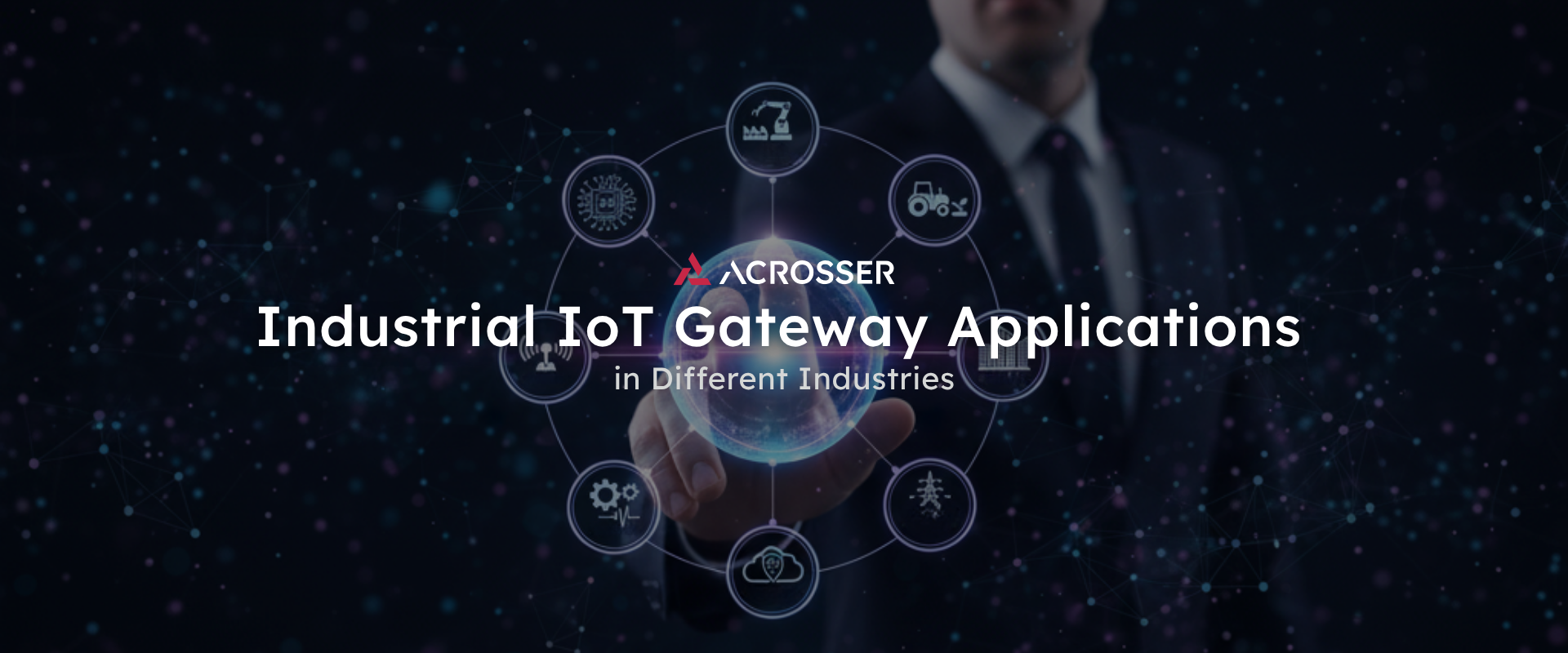
Industrial IoT (IIoT) gateways are proving to be highly versatile as they improve operational efficiency, productivity, and insights across various industrial sectors.
For a detailed explanation of how they operate, see our full guide on Industrial IoT gateway fundamentals.
In this article, we will cover how these devices bridge the gap between the physical world and digital data analysis and control, transforming how industries manage their operations.
Smart Manufacturing: The Backbone of Industry 4.0
IIoT gateways are a critical communication infrastructure that connects industrial robots, production machinery sensors, Programmable Logic Controllers (PLCs), and other automated equipment. This system integration allows for real-time performance monitoring, which is crucial for predictive maintenance strategies that proactively detect potential equipment failures.
Beyond maintenance, IIoT gateways deliver real-time data to edge controllers or SCADA systems, which then adjust machinery on the fly to improve Overall Equipment Effectiveness (OEE). The impact? Reduced operational downtime, improved product quality, and optimized resource utilization. These advantages translate into cost savings and increased output that pave the way for highly efficient, autonomous factories.
A leading example is Siemens’s Electronics Works in Amberg, Germany, where production volume has increased thirteen-fold without increasing the production floor area since 1990, thanks to digital-factory practices. The plant uses IoT-enabled gateways to aggregate machine and sensor data, feed digital-twin models and drive adaptive production workflows across more than 1,000 variants per day.
Precision Agriculture: Cultivating Data for Optimal Yields
In precision agriculture, IIoT gateways are instrumental for collecting and transmitting environmental data from soil sensors, weather stations, drones, and intelligent irrigation systems. This data allows farmers to optimize their operations with greater accuracy.
They can water precisely when needed, apply the exact amount of fertilizer and pest control, and closely monitor crop health. Data-driven decisions mean farmers can achieve higher yields, reduce waste, and implement more sustainable farming practices that benefit both their business and the planet.
For example, John Deere deployed connected agriculture solutions that leverage IoT sensors and gateways to link tractors, field sensors, and satellite data. Their system collects soil moisture, crop health and equipment status in real time, then uses analytics to guide variable-rate fertilizer application and optimized irrigation scheduling. The result: improved crop performance, reduced input costs and better resource usage.
Smart Cities: Building Connected Urban Ecosystems
IIoT gateways are key to building smarter, more connected cities. They integrate diverse urban systems — traffic management, smart street lighting, environmental monitoring, and intelligent waste management.
By aggregating data from different sources, IIoT gateways provide city officials with a complete overview of urban operations. Improved city services lead to a better quality of life for residents through less traffic, cleaner air, and more efficient public services. It also helps cities become more sustainable by optimizing resource use and reducing environmental impact.
A strong example of this is in Los Angeles, where the Bureau of Street Lighting uses IoT connected sensors on about 110,000 street lights. The gateways feed performance data, noise levels and traffic information into a central platform, helping the city reduce energy usage, detect outages faster and improve public safety. The program has already delivered energy savings and lowered emissions while supporting broader smart city services such as adaptive lighting and distributed environmental monitoring.
Energy Sector: Powering the Smart Grid
IIoT gateways play a crucial role in developing smart grids. While the stability of the power supply depends on infrastructure, forecasting, and generation capacity, IIoT gateways boost grid responsiveness by simplifying the connection of renewable sources like solar and wind.
What’s more, IIoT gateways enable proactive maintenance of vital infrastructure, such as transformers and power lines, by continuously monitoring their status. This results in a more efficient, reliable, and sustainable way to generate and use energy, making for a resilient and future-ready power network.
A real example comes from Enel’s Infrastructure and Networks division deployed the TXpert™ ecosystem from Hitachi Energy at their substation in Cortina d’Ampezzo, Italy. The ecosystem includes smart sensors, data-aggregation modules and continuous analytics to monitor transformer health, ageing and performance. The initiative is designed to optimise operations and reduce risk of failure in a demanding alpine environment.
Remote Asset Management: Overseeing Dispersed Operations
For industries managing geographically dispersed assets, such as oil and gas and transportation, IIoT gateways act as a central hub for tracking the location and performance of equipment, monitoring pipelines or vehicles, and spotting potential problems early on.
This approach allows for timely maintenance, significantly reduces operational downtime, and enhances overall safety protocols in hazardous or remote environments. For transportation and logistics, the benefits include more streamlined workflows, improved transparency throughout the supply chain, and more effective fleet coordination, resulting in faster deliveries and lower operating expenses.
For instance, Oklahoma Natural Gas deployed Sierra Wireless AirLink gateways across field sites to collect pressure and flow data, send alerts, and manage assets in hazardous locations. The gateways are Class I Division II rated and provide near real time monitoring and remote management for pipeline operations. This reduced on-site visits and improved safety for dispersed assets.
Healthcare: Patient Care and Hospital Efficiency
In healthcare, IIoT gateways securely collect and transmit vital patient data from wearable devices and remote monitoring systems. This allows for continuous remote oversight and proactive intervention, especially for patients with chronic conditions or those needing post-operative care.
Aside from patient care, IIoT gateways also improve hospital efficiency by tracking equipment, optimizing resource allocation, and streamlining administrative processes. Continuous remote care with faster responses, a more efficient hospital, and simpler paperwork ultimately translates to better patient care at reduced costs.
For example, Philips partnered with Cassia Networks to deploy Bluetooth-connected wearable biosensors and E1000 gateways in a major Dutch hospital’s COVID-19 ward. The gateways transmitted patient vitals such as heart rate and respiratory rate wirelessly to a dashboard, reducing risk of cross-infection for staff, cutting routine checks, and improving monitoring for high-acuity patients.
Robotics & Autonomous Systems: Tomorrow’s Factories Today
Industrial IoT gateways enable robots and autonomous systems to move beyond predefined tasks and respond dynamically to changing operations. These gateways link robot controllers, sensors, vision systems and cloud or edge intelligence, allowing machines to collaborate, adapt and self-optimize.
In a modern factory, robots and physical AI can receive sensor input about part presence, quality inspection results and production flow disruptions. The gateway collects this data from their controller (via OPC UA or Modbus), aggregates or filters it at the edge, and sends key insights to a cloud or local AI model. The outcome is robots that adjust their speed, path or tooling based on real-time conditions, improving throughput and reducing waste.
Looking ahead the robotics-IIoT gateway combination is unlocking “fog robotics” architectures. In these setups, robot decisions occur close to the edge via gateways, which host compute and networking locally, reducing latency and dependence on distant clouds.
From autonomous mobile robots navigating factory floors to robot arms collaborating with humans in smart cells, gateways provide the connectivity, protocol translation and data flow that make these systems flexible and future-ready. The result is not just automation, but adaptive, intelligent automation.
The Upshot
IIoT gateways are key to improving operations and driving strategic progress in many industries. They boost efficiency, promote sustainability, and enhance decision-making. By seamlessly connecting with, gathering, and sending data from various industrial assets, these gateways lead to more intelligent, responsive, and productive outcomes, unlocking the full potential of interconnected systems.
Looking to deploy IIoT in your operations?
ACROSSER offers industrial-grade edge computing and IoT integration solutions designed for reliable, secure connectivity across manufacturing, energy, smart cities, and more.

Monthly insights and updates. No spam. Just what matters.
We partner with tech leaders to turn ideas into reality, from concept to deployment.
